


Year 12 reminder - please can you make sure to post up your case study information on the blog. I can't see everyone's and it needs to be up there.
Year 13 - same goes for you. You need to begin developing your research on this case study NOW.
Popular Posts
-
AQA A2 Media Studies | How To Get The Top Grades Caroline Bagshaw | Thursday August 25, 2011 Categories: Courses , A Level , AQA A Leve...
-
FANTASTIC Media Terms Site http://brianair.wordpress.com/film-theory/glossary-of-media-terminology/
-
We are now up and running with Mediaedu. Don't forget your usernames and the password is jmmediastudies. You should use this site as ...
-
Year 12 Work Wednesday and Thursday - planning a case study answer and presenting it. A walking talking exam answer. To do: Brainstorm ...
-
A2 AQA MEST3 Revision New and Digital Media Example Question Jeremy Orlebar | Saturday May 22, 2010 Categories: Courses , A Level , AQA...
-
Question 7 0 7 ‘ To connect, to create, to share creativity or thought, to discuss, to collaborate, to form groups or to combine with other...
-
Outnumbered is a successful British Situation Comedy (Sitcom) named so simply because the two parental central protagonists, ‘Sue’ and ‘Pet...
-
Questions: Consider how the music videos use mise-en-scene to represent the artists in a specific light. the mise en scene at the...
-
The world first heard about the death of Michael Jackson from the online gossip website TMZ. How has new/digital media changed the ways in w...
-
Why do Media institutions rely so heavily on new technology to market their products? In the modern media landscape, new technology ...
Tuesday, 6 November 2012

Friday, 2 November 2012
Do You Believe That The Media Is Responsible For Continuing To Create Stereotypical Representations Of Class
The Media has a huge role to play in how we perceive representations of different groups of people, and espcially in the UK, class is a hugely represented issue. Shows such as Shameless portray the working class in a negative light, with an emphasis on taking drugs, living on the dole, and crime. Whilst shameless has a comedic element and is not meant to be a documentary, it does make certain comments on that class of people, and in many ways could be seen to fuel a stereotype of the working class. Additionally, shows such as Eastenders perpetuate the stereotype of the working class as brash and argumentative, and their narrative consistently uses high drama to engage the audience. Downton Abbey represents a class from a different era, and winds a duel narrative of 'upstairs' and 'downstairs' so that audiences are offered an insight into both upper and lower classes. one of the producers of Downton noted that they used different camera shots and colours for upstairs and downstairs in order to gain a different feel. The shots upstairs used a wide angle lense and colours were bright and sumptuous. When they filmed downstairs they used a more narrow camera shot and darker colours, to give them impression of enclosed space.Newspapers and the news have a respnosibility to create representations of class and to either fuel or challenge stereotypes. The Daily Mail is targeted at the middle classes, but represents certain groups in a specific light. It can be quite damning of the upper class and of their way of life, and often it's sensationalist headlines target issues such as the MP scandal or tax evasion of the rich. Likewise, The Sun continues to represent the working class as celebrity obsessed people who are not interested in political issues and debates. Their continuation of Page 3 and of exploitation of women also ties in with an expectation that the working class men would be interested in such things. Additionally, shows such as This Morning and Day Break could be seen to be continuing a representation of the middle classes as being attractive and white as they are always presented by similar looking people. The class system in Britain is represented in the Media in both positive and negative ways, but more often than not Media texts tend to perpetuate steretypes that we have of all of the different classes.
Thursday, 1 November 2012
Marxism
A sociological approach to literature that viewed works of literature or art as the products of historical forces that can be analyzed by looking at the material conditions in which they were formed. In Marxist ideology, what we often classify as a world view (such as the Victorian age) is actually the articulations of the dominant class. Marxism generally focuses on the clash between the dominant and repressed classes in any given age and also may encourage art to imitate what is often termed an "objective" reality. Contemporary Marxism is much broader in its focus, and views art as simultaneously reflective and autonomous to the age in which it was produced. The Frankfurt School is also associated with Marxism (Abrams, p. 178, Childers and Hentzi, pp. 175-179). Major figures include Karl Marx, Terry Eagleton, Fredric Jameson, Raymond Williams, Louis Althusser (ALT-whos-sair), Walter Benjamin (ben-yeh-MEEN), Antonio Gramsci (GRAWM-shee), Georg Lukacs (lou-KOTCH), and Friedrich Engels, Theordor Adorno (a-DOR-no), Edward Ahern, Gilles Deleuze (DAY-looz) and Felix Guattari (GUAT-eh-ree).
Key Terms (note: definitions below taken from Ann B. Dobie's text, Theory into Practice: An Introduction to Literary Criticism - see General Resources below):
A sociological approach to literature that viewed works of literature or art as the products of historical forces that can be analyzed by looking at the material conditions in which they were formed. In Marxist ideology, what we often classify as a world view (such as the Victorian age) is actually the articulations of the dominant class. Marxism generally focuses on the clash between the dominant and repressed classes in any given age and also may encourage art to imitate what is often termed an "objective" reality. Contemporary Marxism is much broader in its focus, and views art as simultaneously reflective and autonomous to the age in which it was produced. The Frankfurt School is also associated with Marxism (Abrams, p. 178, Childers and Hentzi, pp. 175-179). Major figures include Karl Marx, Terry Eagleton, Fredric Jameson, Raymond Williams, Louis Althusser (ALT-whos-sair), Walter Benjamin (ben-yeh-MEEN), Antonio Gramsci (GRAWM-shee), Georg Lukacs (lou-KOTCH), and Friedrich Engels, Theordor Adorno (a-DOR-no), Edward Ahern, Gilles Deleuze (DAY-looz) and Felix Guattari (GUAT-eh-ree).
Key Terms (note: definitions below taken from Ann B. Dobie's text, Theory into Practice: An Introduction to Literary Criticism - see General Resources below):
Commodificaion - "the attitude of valuing things not for their utility but for their power to impress others or for their resale possibilities" (92).
Conspicuous consumption - "the obvious acquisition of things only for their sign value and/or exchange value" (92).
Dialectical materialism - "the theory that history develops neither in a random fashion nor in a linear one but instead as struggle between contradictions that ultimately find resolution in a synthesis of the two sides. For example, class conflicts lead to new social systems" (92).
Material circumstances - "the economic conditions underlying the society. To understand social events, one must have a grasp of the material circumstances and the historical situation in which they occur" (92).
Reflectionism - associated with Vulgar Marxism - "a theory that the superstructure of a society mirrors its economic base and, by extension, that a text reflects the society that produced it" (92).
Superstructure - "The social, political, and ideological systems and institutions--for example, the values, art, and legal processes of a society--that are generated by the base" (92).
Wednesday, 31 October 2012
Examiner's Report June 2011 Exam. Read this through and look at it when reflecting on your mock exam.
Section A: Texts, Concepts and ContextsThe vast majority of centres and their candidates have now clearly acclimatised themselves
to the demands of Section A. Most responses were appropriately succinct and focused.
Many were able to achieve a high hit-rate of ideas and close reference to the unseen textthus ensuring a level three or above. Stamina remains an issue for some candidates
although there was far less evidence of responses collapsing completely by question four.
Far fewer responses were theory-lead and if/when media theories were used they were often
applied well to the question at hand. One key concern though for many candidates was to
ensure that they took note of the key concept heading of each question and that their answer
was actually relevant to this area. Many either repeated ideas from other question/concept
areas or produced irrelevant responses because of an inappropriate concept being explored.A valuable lesson to be learnt for many is to make certain that during the note-taking stage of
the exam, ideas are generated for each question in relation to the specific key concept
heading.Question 1: Media FormsThis was once again the best answered question, with well over a third of candidates
achieving a level three or above. Many responses showed sound understanding of media
techniques such as lighting, transitions, camerawork, sound and mise-en-scene. Slightly less
secure, however, was use of media terminology. Candidates on the whole seem comfortable
with the difference between diegetic and non-diegetic sound but less assured when
describing shot types and editing.
Unfortunately less successful candidates, although showing sound understanding of media
language were unable to focus on how techniques were used to compress time. Narrative
theory was a useful aid here, with some applying theories such as Todorov to consider the
narrative closure of the advertisement.
Many candidates unfortunately decided not to focus on media forms at all, instead using a
range of other concepts (often representation or audience) to analyse the text in a general
way rather than answering the question at hand. The best example of this was the everpopular
reference to the colour red (as worn by the lead character throughout). Rather than
relating this to how it aided the audience’s understanding of the compression of time, many
just linked it to representation through its connotations of passion and love. An interesting
observation but largely irrelevant in this case.
Question 2: Media InstitutionsThis question was also fairly well-answered by candidates with just under a third achieving
level three or above. The majority of responses were secure in their knowledge of what
brand image stood for (most commenting on family values) but many had difficulties with
commenting on how these values were communicated through the textual construction of the
advertisement (in order to achieve a level three). Less successful answers tended to focus
purely on the appearance of the products sold by John Lewis rather than the values
promoted.
Report on the Examination – General Certificate of Education (A-level) Media Studies – MEST1 –
June 2011
4
Question 3: Media RepresentationsAgain this was a fairly well-answered question with over a third of responses achieving a
level three or above. Successful responses were able to show how the representation of
femininity was constructed in the advertisement. Weaker responses though, tended to just
describe the life of the actual woman in the advertisement rather than showing a wider
understanding of how media texts construct gender representations.
There was less evidence of textual detail in many responses (as perhaps candidates who
had not made detailed notes during the viewings had by now forgotten key moments). Such
responses in turn tended to latch desperately onto the examination paper’s introduction
merely repeating ideas and sometimes actual quotations from BlogSpot and Mumsnet.
However, many level four responses used the information provided well. They were able to
successfully navigate between the conflicting interpretations of the advertisement and the
contradictory representations on offer. Stereotyping was in turn alluded to (particularly the
1950s housewife) and wider discussions of feminism developed. Analyses of how female
representation was strongly linked to age and class within the advertisement were also
effectively produced.
Question 4: Media AudiencesThis was unfortunately the least well-answered question with only just over a quarter of
candidates achieving a level three or above. The defining characteristic of successful
responses was their ability to consider the pleasures provided by the advertisement itself
rather than the brand. Many candidates developed ideas more in keeping with question two,
identifying John Lewis’ values (most often related to family) and linking this to audience
response. Another common approach was to merely focus on the loyalty that John Lewis
provided the consumer, apparently shown through the range of products (particularly
clothing) featured in the text.
More successful responses were able to isolate pleasures that the advertisement provided
such as nostalgia, aspiration, high emotion and narrative compression. Theories were also
applied well, most notably Uses and Gratifications, Altman’s Genre Pleasures and Maslow’s
Hierarchy of Needs. Less useful were the Hypodermic Needle Effect and JICNARS scale
which tended to take responses away from the focus of the actual question.
Section A: Texts, Concepts and ContextsThe vast majority of centres and their candidates have now clearly acclimatised themselves
to the demands of Section A. Most responses were appropriately succinct and focused.
Many were able to achieve a high hit-rate of ideas and close reference to the unseen textthus ensuring a level three or above. Stamina remains an issue for some candidates
although there was far less evidence of responses collapsing completely by question four.
Far fewer responses were theory-lead and if/when media theories were used they were often
applied well to the question at hand. One key concern though for many candidates was to
ensure that they took note of the key concept heading of each question and that their answer
was actually relevant to this area. Many either repeated ideas from other question/concept
areas or produced irrelevant responses because of an inappropriate concept being explored.A valuable lesson to be learnt for many is to make certain that during the note-taking stage of
the exam, ideas are generated for each question in relation to the specific key concept
heading.Question 1: Media FormsThis was once again the best answered question, with well over a third of candidates
achieving a level three or above. Many responses showed sound understanding of media
techniques such as lighting, transitions, camerawork, sound and mise-en-scene. Slightly less
secure, however, was use of media terminology. Candidates on the whole seem comfortable
with the difference between diegetic and non-diegetic sound but less assured when
describing shot types and editing.
Unfortunately less successful candidates, although showing sound understanding of media
language were unable to focus on how techniques were used to compress time. Narrative
theory was a useful aid here, with some applying theories such as Todorov to consider the
narrative closure of the advertisement.
Many candidates unfortunately decided not to focus on media forms at all, instead using a
range of other concepts (often representation or audience) to analyse the text in a general
way rather than answering the question at hand. The best example of this was the everpopular
reference to the colour red (as worn by the lead character throughout). Rather than
relating this to how it aided the audience’s understanding of the compression of time, many
just linked it to representation through its connotations of passion and love. An interesting
observation but largely irrelevant in this case.
Question 2: Media InstitutionsThis question was also fairly well-answered by candidates with just under a third achieving
level three or above. The majority of responses were secure in their knowledge of what
brand image stood for (most commenting on family values) but many had difficulties with
commenting on how these values were communicated through the textual construction of the
advertisement (in order to achieve a level three). Less successful answers tended to focus
purely on the appearance of the products sold by John Lewis rather than the values
promoted.
Report on the Examination – General Certificate of Education (A-level) Media Studies – MEST1 –
June 2011
4
Question 3: Media RepresentationsAgain this was a fairly well-answered question with over a third of responses achieving a
level three or above. Successful responses were able to show how the representation of
femininity was constructed in the advertisement. Weaker responses though, tended to just
describe the life of the actual woman in the advertisement rather than showing a wider
understanding of how media texts construct gender representations.
There was less evidence of textual detail in many responses (as perhaps candidates who
had not made detailed notes during the viewings had by now forgotten key moments). Such
responses in turn tended to latch desperately onto the examination paper’s introduction
merely repeating ideas and sometimes actual quotations from BlogSpot and Mumsnet.
However, many level four responses used the information provided well. They were able to
successfully navigate between the conflicting interpretations of the advertisement and the
contradictory representations on offer. Stereotyping was in turn alluded to (particularly the
1950s housewife) and wider discussions of feminism developed. Analyses of how female
representation was strongly linked to age and class within the advertisement were also
effectively produced.
Question 4: Media AudiencesThis was unfortunately the least well-answered question with only just over a quarter of
candidates achieving a level three or above. The defining characteristic of successful
responses was their ability to consider the pleasures provided by the advertisement itself
rather than the brand. Many candidates developed ideas more in keeping with question two,
identifying John Lewis’ values (most often related to family) and linking this to audience
response. Another common approach was to merely focus on the loyalty that John Lewis
provided the consumer, apparently shown through the range of products (particularly
clothing) featured in the text.
More successful responses were able to isolate pleasures that the advertisement provided
such as nostalgia, aspiration, high emotion and narrative compression. Theories were also
applied well, most notably Uses and Gratifications, Altman’s Genre Pleasures and Maslow’s
Hierarchy of Needs. Less useful were the Hypodermic Needle Effect and JICNARS scale
which tended to take responses away from the focus of the actual question.
Tuesday, 30 October 2012
Hi all,
Hope you've had a good half term. Interestingly I notice that not one of you has been on your blogs over half term. This tells me that you are not taking it seriously enough! You MUST update your blogs with interesting things you see, but especially things to do with your case study.
I had a quick think about a film that represented class; a film called The Angel's Share. Below are my findings from 12 minutes of work. Yes I may be a Media Studies and English teacher, but you don't need to do much to find info on films! You must get this sorted ASAP as I am expecting to see all of your films posted online in the next week, with resources and information about them and some analysis of the resources that you have chosen.
<iframe width="560" height="315" src="http://www.youtube.com/embed/NcQIvmR21VU?rel=0" frameborder="0" allowfullscreen></iframe>
Here is a review from The Observer website. Because the observer has a higher class of readership, and is aimed at middle and upper class people, the review is very much targeted at them. It contains a mixture of information about the director, which suggests that the audience might already know who he is, and it also contains information about the film itself. It promotes the film in a favourable way with sentence such as 'warm hearted' and 'deft' suggesting that the Observer enjoyed the film.


Hope you've had a good half term. Interestingly I notice that not one of you has been on your blogs over half term. This tells me that you are not taking it seriously enough! You MUST update your blogs with interesting things you see, but especially things to do with your case study.
I had a quick think about a film that represented class; a film called The Angel's Share. Below are my findings from 12 minutes of work. Yes I may be a Media Studies and English teacher, but you don't need to do much to find info on films! You must get this sorted ASAP as I am expecting to see all of your films posted online in the next week, with resources and information about them and some analysis of the resources that you have chosen.
<iframe width="560" height="315" src="http://www.youtube.com/embed/NcQIvmR21VU?rel=0" frameborder="0" allowfullscreen></iframe>
Here is a review from The Observer website. Because the observer has a higher class of readership, and is aimed at middle and upper class people, the review is very much targeted at them. It contains a mixture of information about the director, which suggests that the audience might already know who he is, and it also contains information about the film itself. It promotes the film in a favourable way with sentence such as 'warm hearted' and 'deft' suggesting that the Observer enjoyed the film.
The Angels' Share – review
Ken Loach expertly combines comedy with politics – and a drop of the hard stuff – in a warm, deftly-plotted heist movie
 Email
Email
'We fervently wish for their caper to succeed': the heist crew in Ken Loach's The Angels' Share.
Though not generally considered a comedy director, Ken Loach has made films that have contained some of the funniest moments and sequences of the past 50 years, and he has regularly employed club comedians in serious roles (Crissy Rock in Ladybird Ladybird, John Bishop in Route Irish) and developed the talents of people such as Ricky Tomlinson not previously considered comics. It's just that Loach is a master of sudden, disturbing shifts of mood, and the comedy is embedded in works that are often deeply sad or tragic. The football game, for instance, that Brian Glover referees in Kes is at once hilariously funny and a brilliant study of bullying, bad education and humiliation that illuminates the film's larger context.
The background of The Angels' Share, his latest collaboration with the leftwing Scottish lawyer turned screenwriter Paul Laverty, is the widespread, seemingly permanent youth unemployment and the despair and communal erosion it engenders. But the realistic and humanistic tone is bracingly optimistic, and it's one of the 75-year-old Loach's sprightliest films, made at an age when most directors have hung up their viewfinders, entered a period of terminal decline or settled for repeating themselves.
The movie begins with a group of criminals brought together by chance in the manner of The Usual Suspects and gradually modulates into a heist comedy that combines two classic Scottish films, both directorial debuts from different eras, Alexander Mackendrick's Whisky Galore!(1949) and Bill Forsyth's That Sinking Feeling (1980).
The young offenders, played by non-professional actors who perform brilliantly under Loach's sympathetic direction, are introduced at Glasgow's City Court when pleading guilty to a variety of crimes. Their demeanour is playfully contrasted with the solemnity of the bewigged judge, and most of the offences are quite minor – petty theft, defacing public statues, drunkenness in a public place. However, one of the defendants, Robbie (Paul Brannigan), is up for grievous bodily harm, and he's only saved from another custodial sentence because his girlfriend is eight months pregnant.
All of them are given community service and are fortunate to come under the supervision of Harry (John Henshaw, a familiar face from TV drama and the occasional movie), a middle-aged, working-class Mancunian who forges a bond with Robbie. He's as sympathetic a figure as Colin Welland's teacher in Kes and Peter Mullan's soccer coach in My Name is Joe and brings a wealth of unpatronising understanding to his charges' lives and problems. The unemployed Robbie, determined to go straight and be a good father, appears to have everything against him – a history of violence (there's a revealing razor scar on his left cheek) and his girlfriend's brutal father, who's determined to get him out of Glasgow and away on his own, whether by force or bribery. Harry could be his salvation.
At this point a major dramatic and thematic device appears to link the action, the humour and the ironic morality, and it's whisky. Harry is a connoisseur of fine single malt. He pours a dram to celebrate Robbie's fatherhood. He takes the group of offenders, who are doing public service, painting old community centres and cleaning cemeteries, on a tour of a distillery and then to a whisky tasting in Edinburgh. These occasions constitute a delightful documentary on scotch, its history, production and consumer appreciation. By revealing that Robbie has a natural nose for the hard stuff, it also leads to his discovery of a vocation, his return to crime and his ultimate redemption.
In Whisky Galore! some Scottish villagers help themselves when a whisky-laden merchant ship is wrecked on their shores. In That Sinking Feeling some unemployed teenagers in a desolate late 1970s Glasgow plan the robbery of a warehouse containing stainless steel sinks. Crime is not new in Loach's work, and characters in past films, though not explicitly here, clearly believe in the dictum of the French anarchist and social reformer Pierre-Joseph Proudhon that property is theft. They rustle sheep, rob a sporting goods van to equip their football team with strips, make away with the grass from the bowling green of (naturally) a Conservative club.
In The Angels' Share, Robbie and the companions hear of an extremely valuable old whisky being auctioned at a Highland distillery and plan an ultra lo-tech heist to give them the nest-egg they need. You might infer here that the thieves believe whisky is part of the Scottish legacy that the boys' ancestors were robbed of when the Highland clearances took place. The unwitting participants in their plot are Harry, who has encouraged Robbie's newfound passion, and a sophisticated broker who deals in rare whisky (the excellent Roger Allam who, coincidentally, has a strong resemblance to Alexander Mackendrick).
So there is politics underlying every aspect of this funny, warm-hearted, deftly plotted film, and we fervently wish for the caper planned by this endearing quartet to succeed. We care for them in a way we don't for the cool, cynical confidently smirking George Clooney in his slickOcean's Eleven heist movies. The film's title, The Angels' Share, is apparently the term used to refer to the 2% of whisky that evaporates in the cask each year. An interesting item of distilling lore, it's initially a joke about capitalist exploitation that turns at the end of the film into a metaphor for generosity and gratitude.
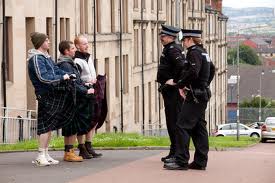
The stills from the film suggest a defiance against authority, and represent the characters as willing to stand up against the law, and as quite rebellious. Additionally, the trailer represents Scottish people as fond of a drink, and as people who get into trouble with the law. This could be seen to be a little stereotypical by some audiences (would link with reception theory here).
Audiences would feel an affinity to this film because it is, like the Observer reviewer noted, 'warm hearted' and the feeling within the trailer is similar to that of the trailer to the Full Monty. The Full Monty ....(go on to detail some of the info about this).....similarly The Angel's Share (info about what it took at the box office)....
Because the institution that made this film made it with a fairly low budget (info about the budget), the film's setting is fairly local and obviously didn't cost a lot of money.
Course work timetable for JHH and GLM
Date
|
Essay
|
Theories
Research tools
|
Linked production
|
Wed 7th Nov
|
Analysis of Primary text
Use these headings in your analysis and write in full sentences
· Audience
· Codes and conventions
· Media language
· Genre/narrative
· Representation
|
Chapter 3 of text book
· audience theory
· Dyer’s theory p144
· semiotics
· post structural analysis
· Barthes
· feminist theory
|
Research audience
Codes and conventions of your chosen product
|
Wed 14th Nov
|
Analysis of Primary text
Ideology/values
Institution
|
· Marxist theory
· Gramsci
· Liberal pluralism
|
Research branding and create your own
|
Wed 21st Nov
|
Start to really answer your question
Analysis of secondary sources
How do they contextually link to your issues/ wider media debates?
Analyse for appropriate key concepts and theories
|
Use chapter 1 of text book
|
Photograph portfolio week
Start to create product
|
Wed 28th Nov
|
Start to really answer your question
Analysis of secondary sources
Add in your linked production piece – how does it add to your investigation?
|
Formal presentation of your research
Include key concepts, theories, media language and your clear intentions for your product linking it to your critical investigation
| |
Wed 5th Dec
|
Now look for expert opinion
Research recent studies
|
Use web links that I will give you
|
Create your products
|
Wed 12th Dec
|
Start to put together as rough draft.
Pull out 6 key points that you
|
Completed one draft of your product
|
Friday, 19 October 2012
Year 12 Homework
Research and prepare for a presentation on your case study. Should include minimum of 2 films, and should detail, amongst other things:
- information about the release
- detailed info about the martketing of the film.
- Information about the audience.
- Details of youtube hits for the trailer, and of any other content on youtube about the film.
- Images and still from the films.
- Information about the online presence of the film, specifically on digital media and it's presence on social networks.
Enjoy your half term and keep your eye out for any articles in papers that are Media related!
Year 13 Homework
Is pretty much the same as year 12! However, please can you add an additional strand to your homework which is
'How has new and digital media impacted on the film industry?'
I will want to see presentations of ideas from all of you, but more importantly I want you to be able to be quizzed on your films and your representations and be
able to tell me EVERYTHING. It's a small ask I know....
You will be doing a practice question first lesson back with me, so make sure you have fully prepared your case study over half term. I am expecting to see evidence of at least 6 hours of work from all of you.
Subscribe to:
Posts (Atom)